
St. Charles, IL · Garage Door Service
Garage Door Service for Algonquin Homes
Garage door repair and tune-ups for Algonquin's mostly 1990s housing stock, run out of St. Charles. Springs, openers, and the parts that era actually used.
- Repairs & new doors
- Springs & openers
- Serving 7 nearby communities
Where This Job Goes Sideways
Algonquin's median year built lands around 1994, a good decade and a half newer than the 1981 median we see across the rest of the service area we cover. That matters more than it sounds like it should. A door and opener installed in a house built in '94 is old enough to be tired but young enough that it was probably never touched - no upgrade, no mid-life spring swap, nothing. The original torsion spring is usually still on the shaft. The original opener, if it's a chain-drive unit from that era, is usually still bolted to the ceiling joist with the same worn sprocket and the same logic board capacitor that's been slowly drying out for thirty years.
Where it goes sideways is the gap between "still works" and "still safe." A spring from 1994 has had three decades of cold-weather cycling - and this region sits in a cold, moderate climate band, so that's thousands of extra contraction-expansion cycles compared to a milder zone. When it finally lets go, it tends to go all at once, not gradually. We see it most on the original hardware nobody thought to ask about because the door itself still looks fine.
Parts We Carry
For a house from the early-to-mid '90s, we're usually looking at a 7-foot standard garage opening, torsion springs sized for a steel sectional door, and either a chain-drive or early screw-drive opener depending on what the builder spec'd. We carry torsion springs in the common sizes that run that era's doors, standard-lift cable, nylon and steel rollers, and universal opener logic boards and gear-and-sprocket kits that fit most chain-drive units from that generation.
We don't stock every obsolete part. If a house has a less common opener brand or a custom panel size, we may need to order it, and we'll tell you that up front rather than make you wait at the door guessing. That's the one honest limit here - same-day fixes cover the common stuff, not everything.
What the Fix Involves
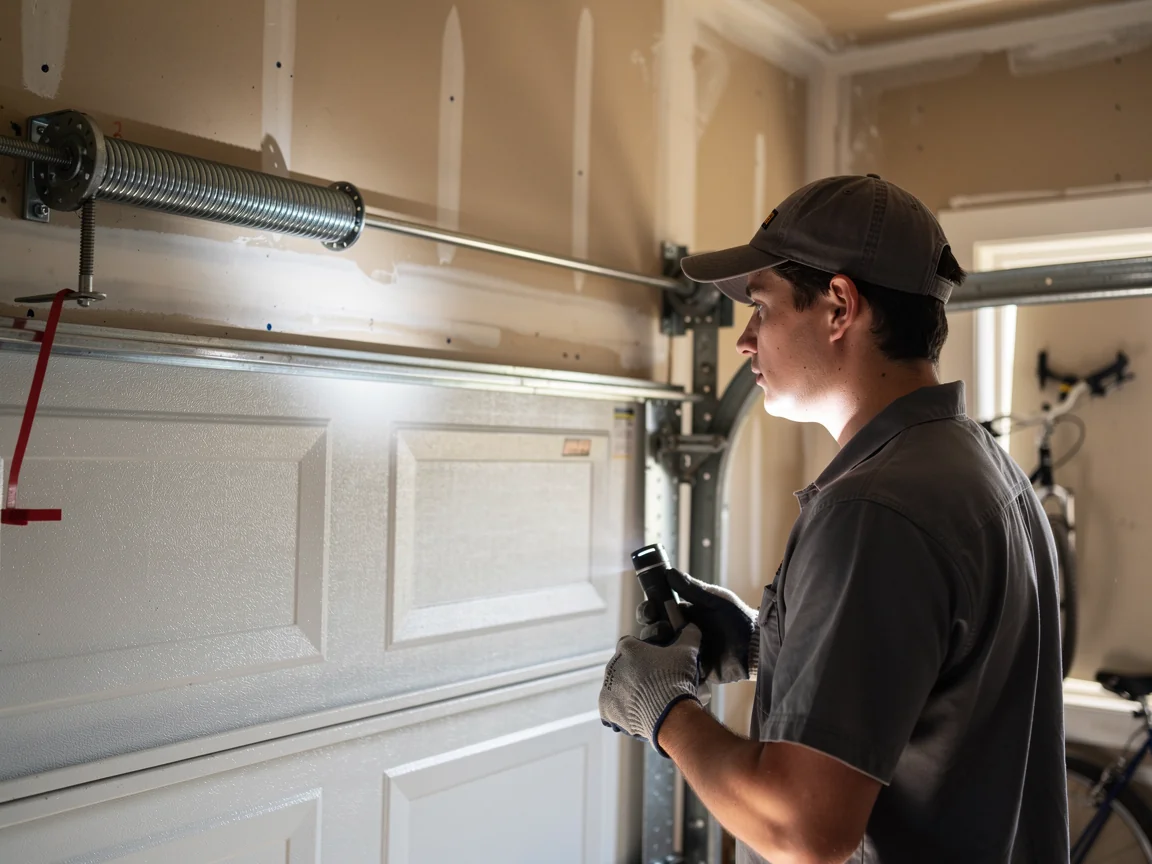
Most calls in this kind of housing stock start with a spring or cable check, because that's the part that's been running since the house was built. We pull the door, inspect the torsion spring for stretch and rust pitting, check the cable ends and drum bolts, and look at the track alignment - 30 years of settling can throw a track out of plumb even if nobody ever touched the door.
On the opener side, if it's original, we check the gear set, the capacitor, and the safety sensors, since those sensors weren't always standard equipment on units from the early '90s and sometimes need to be added to meet current safety expectations. We replace what's failed, not what's merely old - a working chain-drive opener from 1994 doesn't need replacing just because of its age.
Time on the Job
A straightforward spring replacement on original hardware from this era usually runs under two hours once we're on site, parts in hand. Opener work - swapping a logic board or adding sensors - adds time depending on how accessible the wiring is in the attic space above the garage, which varies house to house and isn't something we can estimate without seeing it.
We travel from St. Charles, about 17 miles out to Algonquin, so the job itself is quicker than the scheduling window around it. We'll give you a real window when you book, not a promise about how fast we can get there.
Can You Do This Yourself
A torsion spring under load from a door this old is not a weekend project - the spring has 30 years of tension history on it, and a slipped winding bar on old, possibly rusted hardware is how people end up in the ER. Replacing rollers, lubricating the track, and tightening loose bolts on the opener rail: that's reasonable DIY territory on a house this age, and it's worth doing between service calls.
If the opener is still the original unit from construction, test the auto-reverse safety feature yourself by placing a block on the ground under the closing door. If it doesn't stop and reverse, stop using the opener until it's looked at - that's not a judgment call worth making on your own.
Frequently asked questions
Is the original garage door opener in my Algonquin house still safe to use?
It depends on whether it has working safety reversal sensors - not all openers made in the early '90s came with them standard. Test it with a block of wood under the door; if it doesn't reverse on contact, don't keep using it until we've checked it.
Why does my spring feel fine until it suddenly doesn't?
Torsion springs fatigue gradually from repeated cold-weather contraction and expansion, but they usually fail all at once rather than giving warning. A spring installed when the house was built in the early '90s has had three decades of that cycling.
Do you keep a truck stocked near Algonquin?
No - we run out of St. Charles, about 17 miles away, and bring parts sized for the common door and opener setups from this era's housing stock. Less common parts may need to be ordered ahead of the visit.
Should I replace the whole door or just fix the spring?
If the panels, track, and opener are sound and it's just the spring or cable that failed, repair is usually the right call. Replacement makes more sense when the door itself is dented, warped, or the opener is failing alongside the spring.
More garage door services in Algonquin
Book garage door service in St. Charles
Call now or request a quote - tell us what the door is doing and where you are.