
St. Charles, IL · Garage Door Service
When a Torsion Spring Breaks on a St. Charles Garage Door
St. Charles homes built mostly from 1958 to 2009 wear through garage door springs fast in our cold winters. Here's what a spring repair job actually involves.
- Repairs & new doors
- Springs & openers
- Serving 7 nearby communities
The Symptom
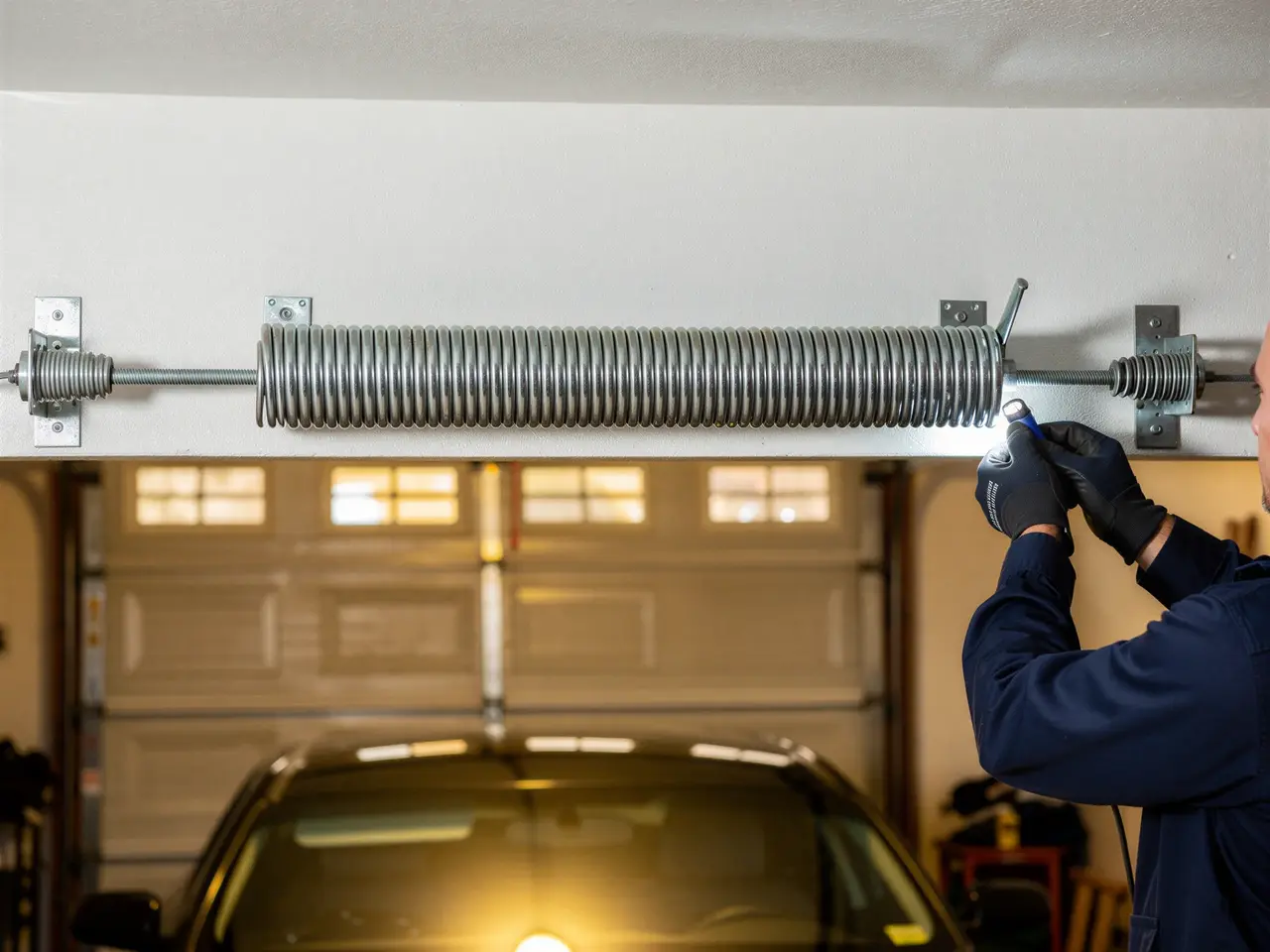
The giveaway is usually a bang from the garage, loud enough that you hear it from inside the house. After that, the door either won't budge or the opener strains and groans trying to lift it on its own. If you pull the release cord and try to lift the door by hand, it feels like dead weight instead of swinging up with that balanced, almost-light feel a working spring gives it. Sometimes there's no bang at all - the spring just loses tension slowly over a few months, and the opener starts working harder each week until it finally trips its safety limit and quits lifting altogether. Either way, the cable can bind or jump the drum once the spring lets go, so if you see a gap in the coil or a cable hanging loose, don't run the opener again until someone looks at it. That's the one point where trying to force the door open does real damage, usually to the opener's gears or the track brackets, on top of the spring you already need to replace.
What the Fix Involves
A torsion spring repair starts with sizing - wire diameter, coil length, and inside diameter all have to match the door's weight, and guessing wrong means the door won't balance right even after the new spring goes on. We back off the old spring's tension, pull the cable drums, swap the spring and bearing plates, then wind the new spring to spec and run the door through a full open-close cycle to check balance by hand before trusting it to the opener again. On doors with two springs, we replace both even if only one broke, since the other is carrying the same age and the same number of cycles and tends to go within weeks of its twin. One limit worth saying up front: we don't carry every wire length and diameter on the truck for oversized or custom-width doors, so an uncommon size can mean a special order and a second trip instead of a same-visit fix. Extension spring setups, less common now but still out there on older doors, get the same balance test and the same two-spring rule when the door's wide enough to use a pair.
Why It Happens Here
Housing across the St. Charles service area was built mostly between 1958 and 2009, with a median build year of 1981, and across the 53 named communities this service covers, the bulk of that stock dates to the 1980s and 90s. That matters because torsion springs have a cycle life - roughly 10,000 open-and-close cycles is typical - and a spring installed when a house was built or last renovated has usually burned through that life by now regardless of how well it was maintained. With 150,753 owner-occupied houses among the 297,379 households in this area, a lot of garages are still running on the spring the house came with. Cold makes it worse. St. Charles sits in a cold, moderate climate band, and steel contracts every time the temperature drops, which stiffens an already-fatigued spring and makes it more likely to let go on the first hard cold snap of the season rather than fail gradually in mild weather. That's why winter mornings bring more spring calls than any other stretch of the year - not because the spring picked that day, but because it was already near the end and the cold tipped it over.
Time on the Job
Most spring jobs are diagnose-and-fix in one visit once we've confirmed the correct spring size for your door, since torsion hardware is standard enough on most residential doors that we stock the common sizes. What takes longer is anything non-standard - a custom door width, a spring wound for an unusually heavy insulated panel, or hardware old enough that the drums and bearing plates need replacing along with the spring itself. We won't quote a firm number over the phone without seeing the door, because a wrong guess on wire gauge means a door that opens but won't hold position, and that's a callback nobody wants. Across the 53 communities this service covers, from Geneva three miles out to Lisle at fourteen, the jobs look the same: pull the old spring, confirm the drum and cable condition, size and wind the replacement, then run it through enough open-close cycles to be sure it holds balance before we leave. If the opener's gears took damage from someone forcing a broken-spring door open, that's a separate repair we'll flag honestly rather than bundle in as if it were part of the spring job.
Frequently asked questions
How do I know if it's the spring and not the opener?
Pull the manual release and try lifting the door by hand. A working torsion spring makes the door feel nearly weightless and it'll stay wherever you let go. If it drops like dead weight or you hear a loud bang before any of this happens, the spring has gone, not the opener.
Why do both springs need replacing if only one broke?
On a two-spring door, both springs go through the same cycles and the same age and weather. If one failed, the other is close behind - often within weeks. Replacing just one leaves mismatched tension that throws off the door's balance.
Can I just use the door with one broken spring for now?
Running the opener against a broken spring puts the full weight of the door on the opener's gears and the remaining cable, which can strip the opener or snap a cable under load. It's a safe wait if you leave the door manually, but don't run the opener until it's fixed.
Is extension spring hardware still around on older doors here?
Yes, mostly on older homes that haven't had the door system updated. It works differently from torsion springs but follows the same cycle-life logic, and we replace it the same way, with a balance check before we call the job done.
By Neighborhood
Spring Repair across the St. Charles area
We also handle spring repair in these St. Charles-area suburbs.
Book garage door service in St. Charles
Call now or request a quote - tell us what the door is doing and where you are.