
St. Charles, IL · Garage Door Service
Garage Door Spring Repair for Wayne, IL Homes
Wayne homes mostly went up in the late 1980s, which means a specific torsion spring setup. We travel 4 miles from St. Charles to fix it.
- Repairs & new doors
- Springs & openers
- Serving 7 nearby communities
Time on the Job
Most houses in Wayne went up around 1988, which puts the garage door hardware squarely in the late-80s torsion era: steel sectional doors, torsion springs mounted on a center bracket over the opening, and extension spring setups on the handful of older detached garages that predate the subdivision boom. That's different from the mix you'd find in parts of the service area built in the 1960s, where extension springs on side rails are still common and the fix looks nothing like this one. On a 1988-era door, the job is almost always a torsion spring swap - matching wire size and wind count to the door weight, not guessing. We come from St. Charles, 4 miles out, so there's no local branch sitting in Wayne, but the drive is short enough that it doesn't change how we schedule the call.
What the Fix Involves
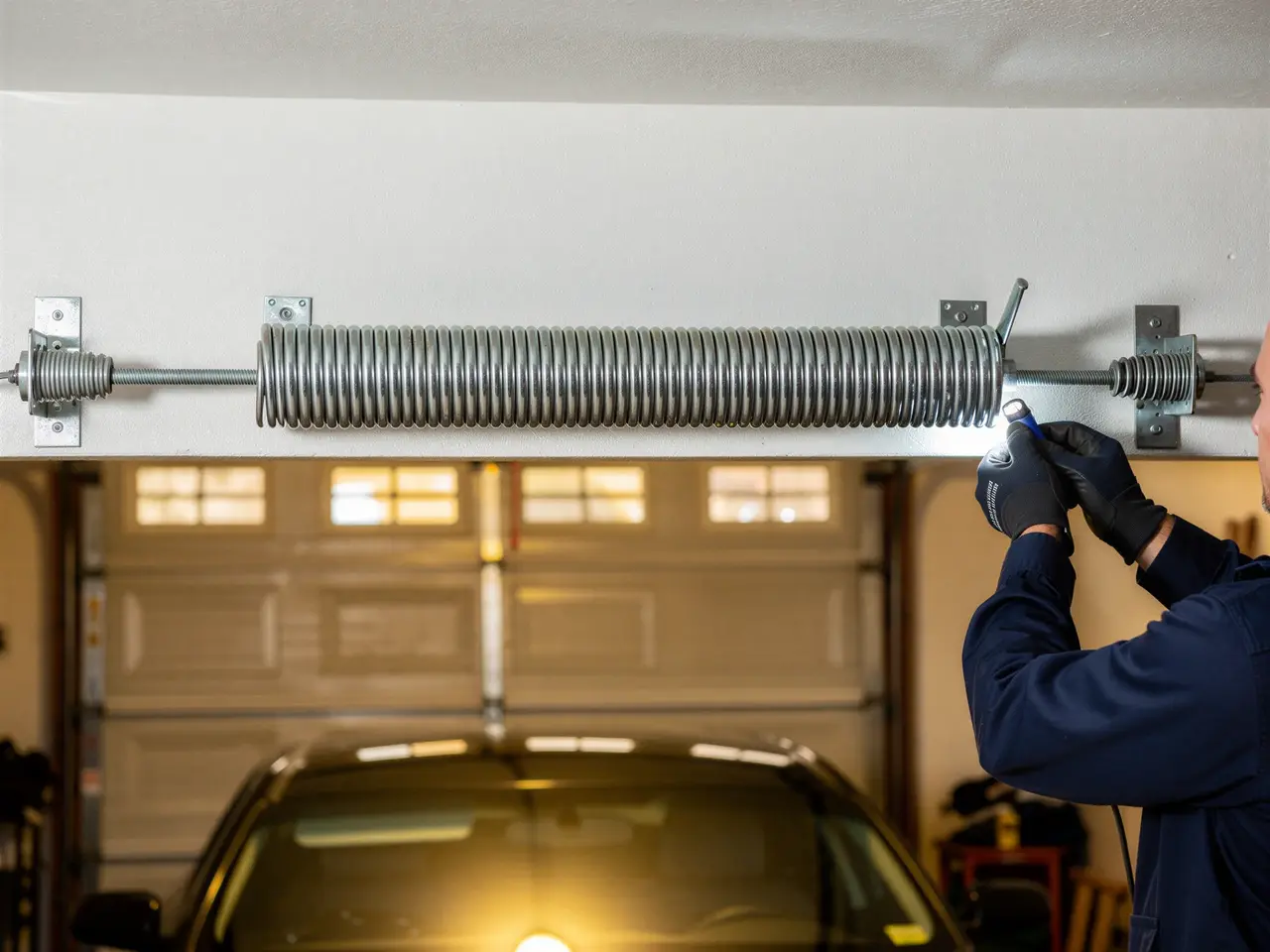
We measure the broken spring - wire diameter, coil length, inside diameter - against the door's actual weight, not just the label on the old part, because late-80s doors sometimes got a heavier insulated panel added later without the spring being upsized to match. Both springs get replaced as a pair even if only one broke; mismatched springs wear unevenly and you'll be back here in a year. We check the center bracket and bearing plates for wear, since 30-plus-year-old steel brackets on original hardware can be worn enough to chew through a new spring fast. Cables and the bottom brackets get a look too, because a spring failure under tension can nick a cable on the way down. Once the new springs are set, we balance the door by hand - it should hold at waist height with the opener disconnected - and adjust tension until it does.
Can You Do This Yourself
A torsion spring is loaded with enough force to break a hand or worse, and the winding bars and tools for a 1988-era center-mount setup aren't something most homeowners keep around for a one-time job. If the door won't open and you can see a gap in the coil above the opening, that's a broken torsion spring - leave it closed and leave the winding to someone who does it daily. What you can check yourself: whether the opener is unplugged before you touch anything, and whether the door is binding on a track versus genuinely spring-dead. If it's binding, that's a different call entirely and not a spring repair.
Why It Happens Here
Wayne's housing stock dates mostly to the late 1980s, and torsion springs from that era are rated for a cycle count - roughly 10,000 open-close cycles - that a door used daily for over 30 years has usually blown past. Add the cold-moderate climate here: steel contracts in winter, and a spring already near the end of its rated life is more likely to snap on a sub-freezing morning than in July. It isn't rust in most cases - galvanized coils in this area hold up - it's fatigue from age and cycle count catching up at once, which is exactly what you'd expect from a subdivision built in one decade now thirty-plus years old.
The Symptom
The door won't budge, or it only moves a few inches before the opener strains and reverses. Look above the door at the horizontal torsion spring: a visible gap in the coil means it's snapped. Sometimes you'll hear it first - a loud bang from the garage, often mistaken for something falling. The opener isn't broken in this case; it's doing exactly what it's built to do, which is refuse to lift a door with no spring tension behind it. Don't force the door by hand or run the opener repeatedly trying to push it through - that strains the opener motor and can bend the top panel.
Booking a Visit
We cover Wayne from our St. Charles location, about 4 miles away, and springs are the kind of repair we can usually get to without a long wait since it's a common call in this area's housing stock. Tell us the door's approximate age and whether it's one spring or two that look broken - it helps us bring the right wire gauge the first time instead of a second trip. See the St. Charles spring repair page for how we handle the job in detail, or check our Wayne coverage page for the rest of what we do in the area.
Frequently asked questions
How old does a garage door spring usually last in Wayne?
Torsion springs are rated for about 10,000 cycles, roughly 7-9 years of daily use, though plenty last longer. With most Wayne homes built around 1988, a lot of original hardware is well past that cycle count now, which is why spring failures cluster in this area regardless of how well the door was maintained.
Is it ever both springs at once?
Usually only one breaks first, but we replace both as a matched pair. A 30-plus-year-old spring that didn't break yet is close behind the one that did, and running mismatched springs - one new, one old - throws off the door's balance and wears the new one faster.
Do you have a shop in Wayne?
No, we work out of St. Charles and drive out, about 4 miles. There's no local branch or drop-in counter in Wayne itself, but the distance doesn't change how we schedule or handle the repair.
Can I just tighten the old spring instead of replacing it?
No. A torsion spring that's broken or badly fatigued can't be re-tensioned safely - the steel itself is spent. Trying to wind more tension into a worn spring risks it snapping under load while someone is standing near it.
Book garage door service in St. Charles
Call now or request a quote - tell us what the door is doing and where you are.