
St. Charles, IL · Garage Door Service
Garage Door Repair for Geneva's Mid-1980s Housing Stock
Geneva's housing mostly went up in the mid-1980s, which means steel sectional doors on original hardware. We cover the repair calls that era produces, from St. Charles, 3 miles out.
- Repairs & new doors
- Springs & openers
- Serving 7 nearby communities
Why It Happens Here
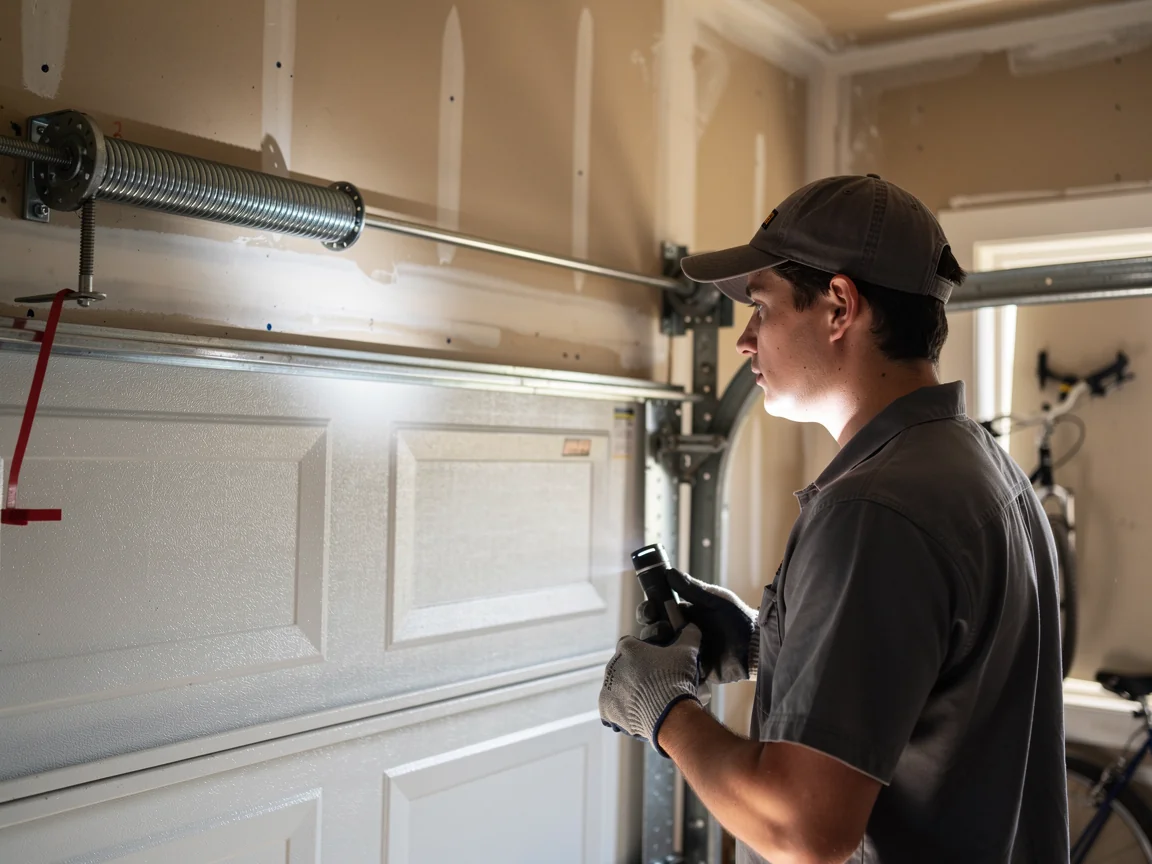
Geneva's median home dates to 1986, which puts most garage doors here in a specific category: steel sectional panels, usually 16x7 for a two-car opening, hung on galvanized track with a torsion spring sized for a door that weighed less than what gets built today. A lot of these are the raised-panel steel look that was standard through the 80s, often with a thin layer of insulation or none at all, and a single bottom seal that's long past its working life. The springs on a door that age are either original or a first replacement, and either way they're closing in on or past the number of cycles they were rated for. With 8,199 households in town and most of that stock from the same decade or two, we see the same failure pattern over and over: the spring that held on through a few thousand cold mornings finally doesn't. Cold matters here because this region sits in a moderate-cold climate band, and steel contracts enough over a winter to put extra load on hardware that's already tired. None of this is dramatic. It's just what 35-plus-year-old steel and springs do, and it's why Geneva calls tend to look alike once you've seen a few.
The Symptom
The call usually starts the same way: the door won't go up, or it goes up a few inches and stops, or it slams down faster than it should. On a torsion-spring door from the mid-80s, that's almost always a spring that's lost tension or snapped outright, sometimes a cable that frayed through on an original drum that was never replaced. On doors that got a replacement opener at some point but kept the original door and track, we also see rollers that have worn their channel wide, so the door rattles side to side even when it's moving fine. Less often, it's a bottom panel that's rusted out at the corner where decades of condensation sat against steel. None of these are opener problems first, even though the opener usually gets blamed first, because that's the part people can see move.
Time on the Job
A straightforward torsion spring swap on a door this age runs about the same time as it would on any double door with standard hardware, assuming nothing unusual turns up once the door's opened up - stripped set screws, a drum that's seized, that kind of thing. We can't give you a number on the page because it genuinely depends on what's underneath once we get the panel open, and a 1986 door sometimes hides a surprise a 2015 door wouldn't. What we can tell you is that the job is a known quantity for us: we see this same era of door constantly across this part of the county, so diagnosing it doesn't take long, even if the repair itself takes the time it takes.
Can You Do This Yourself
Don't touch the torsion spring. That's not a disclaimer, it's the one piece of advice that matters here - a wound torsion spring on a door this size holds enough force to break bones, and the tools to do it safely aren't things most garages have lying around. What you can reasonably check yourself: the bottom seal, whether the tracks are visibly bent, whether the rollers are cracked or worn flat on one side. If your door is original to a mid-80s build and you haven't had the spring replaced yet, treat that as information, not a project. We'd rather talk you out of a DIY spring job over the phone than meet you at the hospital.
Where This Job Goes Sideways
The job goes sideways when someone tries to match a replacement spring or panel to a door this old by eye instead of by the numbers stamped on the original hardware, and ends up with a spring that's close but wrong - too stiff, too light, or the wrong wind direction. It also goes sideways when a homeowner decides to just replace the opener because that's the part that stopped working, without anyone checking whether the real problem is a dead spring putting extra strain on a motor that was never underpowered to begin with. And honestly, sometimes the door itself is the limitation: if the steel's rusted through at the bottom corners or the panels are warped from decades of sun on one side, a spring and roller job is a patch on a door that's closer to the end of its run than the start. We'll tell you that straight rather than keep fixing a door that's done.
Frequently asked questions
Do you have a shop in Geneva?
No - we work out of St. Charles, about 3 miles away, and cover Geneva from there. There's no local branch or depot to call separately; the same crew and the same truck handle both towns.
Why does my 1980s garage door break more than my neighbor's newer one?
Geneva's median home dates to 1986, and a lot of that original hardware - springs, drums, cables - is still in place decades later. Steel and torsion springs have a working life measured in cycles, and a door that old has usually put in more cycles than it was built for.
Is it worth repairing an original door from that era or should I replace it?
Depends on the panel condition more than the age. If the steel's solid and it's just hardware - spring, rollers, cable - repair makes sense. If the bottom panels are rusted through or badly warped, you're patching a door that's near the end of its service life, and we'll say so.
Book garage door service in St. Charles
Call now or request a quote - tell us what the door is doing and where you are.